
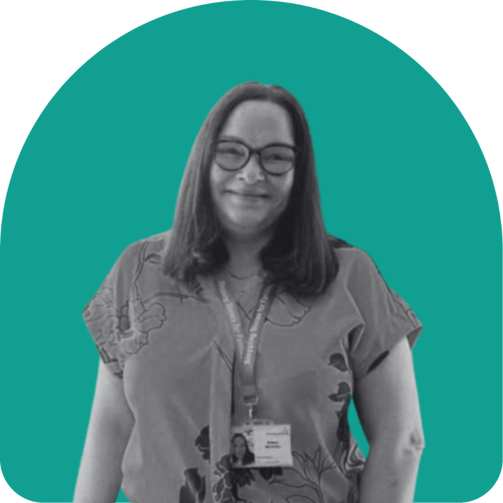
Shona McKellar is Service Manager at Stepping Stones for Families
This project was funded through our Nurturing Relationships theme. Find out more about this theme here.
In this piece, Shona McKellar, Service Manager at Stepping Stones for Families, talks about the work of the organisation's Carrick Money Advice and Family Support Service.
Staff recognise that everyone experiences and reacts to trauma in different ways. We work in a way that gives families a space to talk, be heard and provide them with the support they need at the right time.
What is the project working to achieve?
Stepping Stones for Families' Carrick Money Advice and Family Support Service aims to mitigate the effects of poverty, isolation and exclusion within a rural setting. We equip families with the tools they need to manage everyday life. Once these foundations are in place, many of those we work alongside discover they possess the resources, resilience and confidence to overcome adversity and sustain their own positive change.
What does trauma mean to you in the context of your work?
Many of the families we support have someone who has experienced childhood
trauma, e.g. through abuse, neglect, subjected to substance misuse, domestic
violence etc. All Family Support staff are trauma-informed trained. Staff recognise
that everyone experiences and reacts to trauma in different ways. We work in a way
that gives families a space to talk, be heard and provide them with the support they
need at the right time. A big part of our work involves listening to the stories and
journeys our families want to share and advocating for them with other agencies if
necessary. We also understand that they don’t want to tell their story repeatedly so
support them to make sure this does not happen.
What elements of your service or activities have made the biggest difference for those you work with?
Our person-centered support is not time limited. We take the time to build up
relationships with the families we support. This encourages trust between parent
and worker.
Working holistically with our Money Advice colleagues has a huge impact. Financial
worries create anxiety, stress and worry for families which at times, impacts their
ability to move forward. Our Money Advice Team support families to maximize their
income and helps them in their money management.
Once stress has been alleviated, families appear more ready to work with Family
Support Workers to improve other areas of their lives. It also helps that we run
Groups within the Service. These are popular and provide families with an
opportunity to build up a peer support network and talk about similar experiences
and life journeys. A combination of Money Advice, Family Support and groupwork
works well for families to overcome adversity and sustain their own positive change.
What are the biggest challenges/barriers facing you as an org and/or those you work with/support?
Rural life can be a challenge. Services are not easily accessible for children and
families, and many services become centralised to the nearest town which is some
distance away and not accessible for families due to public transport issues or health
issues.
We are the only Money Advice and Family Support Service based at the
heart of the rural communities we serve. This has resulted in an increased number
of referrals resulting in families having to be placed on a waiting list.
We are constantly looking at innovative ways to reduce this e.g. we invite all families
on our waiting list to school holiday activities. We consider if children on the waiting
list would benefit from attending our Friendship Groups. We invite parents/carers
from our waiting list to join our groups. In some ways this introduces the families to
our service, so they will have already built-up positive relationships before receiving
intensive support. All staff within the service are very passionate about the work we
do and it can be very frustrating to see families kept waiting for intensive support
they need.
How can funders support your work?
Long-term funding and flexibility with funding would support our work along with
more staffing provision to reduce waiting times for families. We serve the entire
Carrick area and recognise that there are families in outlying villages who struggle
to come into our service due to poor transport links. We aim to take our service to
the families in outlying communities. This will require additional capacity. Our
fund finding work is ongoing in order to achieve our aspiration.
Funders could also support our work by visiting the services and really getting
involved in the work carried so that they better understand how and why our
integrated approach has a positive impact on families and communities.
What changes would you like to see in your area of focus during the next decade?
Long-term funding that allows services like ours to forward plan and continue to
provide high-quality provision. We have become a lifeline and vital service in the
community we serve but what if the funding stops? Communities are already facing
cutbacks and centralisation of services. They need stability in the services within
their communities. We recognize that things change for and within communities and
services like ours should be able to evolve with their communities to provide the right
support at the right time.
Not only would longer term funding provide security for services, it also provides
security for the experienced staff working with the services.
We would also like to see Community Hubs in communities where services come
together and work in partnership to provide the right care at the right time for families
in the community.