
Detailed guidance on applying to the Advancing Racial Justice Fund.
If you have any communication support needs that make reading this guidance difficult or impossible, please get in touch with us by emailing arj@therobertsontrust.org.uk or calling 0141 353 4321 to discuss alternative ways to find out about this fund.
Please note that the closing date for applications is 14th October 2026, 9am.
Unconstituted groups (community groups), constituted groups, registered charities and Community Interest Companies (CICs) that:
Are led by people who identify as Black or a Person of Colour; at least 50% of staff, senior leadership, and the Board
Have an annual income of £200,000 or less
Work directly with/within BPoC communities in Scotland
The ARJ Fund resources BPoC-led community groups, charities and CICs to develop and lead work that tackles systemic racism.
By BPoC-led, we mean that at least 50% of your staff, senior management and board are Black or a person of colour. While we use BPoC as a unifying term, we encourage you to be specific about the identities and experiences of your community when you apply, using the language preferred within your community.
Groups and organisations must have an annual income of £200,000 or less. This is normally based on the money your organisation/group received in the last financial year, as shown in your most recent annual accounts or financial statements. We understand, however, that organisation's income may fluctuate from year to year and we’ll therefore look at up to your last three years’ income. If you are a new organisation, which has not yet produced accounts, we’ll look at the income you expect to receive in the year ahead. There are also some cases where we will make exceptions, for example, if your income was over £200,000 due to one-off funding for a capital project. If you are not sure whether you meet this criteria, please get in touch.
If your group or organisation is working directly with individuals and communities, we would usually expect them to be people who also identify as BPoC.
You can still apply if you receive other funding from The Robertson Trust.
£10,000 - £40,000 per year for 3 years
An additional £10,000 upfront to support you to design your project before the project delivery grant begins
This is restricted funding for an anti-racist systems change project. Please see below for more information on what we mean by a ‘systems change project’.
Grants will last for three years, with a minimum of £10,000 per year and a maximum of £40,000 per year. This is in addition to a one-off £10,000 development grant that all grant holders will receive to help them develop their projects. All groups that are awarded a development grant and use this to develop a practical plan of action will receive a project delivery grant. You can read more about this below.
When you apply, you will be asked to:
Provide a budget for how you want to use the £10,000 development grant
Indicate the level of funding you anticipate needing, based on your current income threshold and the scale of your project
You do not need to know the exact amount of funding at this stage. You will have time during the project development phase to develop a detailed budget and confirm your request. Project plans and budgets will go through a final review at the end of the project development phase before project funding is awarded.
As a guide, we would normally expect funding requests to be around 20% of your organisation's annual income. We will consider requests above or below this level where there is a strong case for doing so, taking into account your context, the strength of your application, and the costs developed during the project development phase. We understand that some projects will have additional costs linked to addressing systemic barriers (for example, accessibility or translation). We will consider these on a case by case basis.
If you do not have any income because, for example, you are a small unfunded community group, you are still eligible to apply. There is specific guidance for you below.
You may already have some ideas of what your funding needs are, such as recruiting a new staff member. Please use this to guide your initial funding request.
When considering your budget, remember to consider the full cost of delivery. That is, overhead costs such as work space, travel, materials, HR and so on, as well as fair pay and time calculations.
You don’t need to have any match funding in place when you apply, but if we are not able to fund the total costs of your work, you will need to consider additional sources of funding. Our Funding Officer will discuss this with you during the assessment process. Successful applicants will also have the support of our Funding Officer in seeking out other sources of funding.
Organisations applying for higher levels of funding should be able to demonstrate their willingness and track record of working collaboratively and have clear plans to share learning from their work.
In addition to the grant itself, ARJ grant holders will form a learning community who will meet several times a year to reflect and learn with and from each other. We are hoping that there will also be opportunities to collaborate and take action together.
You will also have access to The Robertson Trust’s general Funder Plus offer [Additional Support | The Robertson Trust] and be supported by the ARJ Funding Officer and Leadership Group, who all have experience in systems change and lived experience of racism.
The ARJ Fund supports groups and organisations with strong community connections who are motivated to tackle systemic racism affecting their communities.
We want to support projects that address a specific systemic racism issue, or create the infrastructure needed to sustain impactful anti-racist movements and build a liberated and equitable future.
We are interested in projects that aim for long-term change by addressing root causes, rather than only responding to symptoms. We are referring to these as systems change projects.
This might include holding decision-makers to account, running public campaigns, building solidarity across groups or movements, media or reporting, or creating a community space that can support organising (see What do you mean by anti-racist systems change? below for more examples).
We do not expect polished project plans at this stage. Instead, successful applicants will have time to explore their issue in more depth and develop their strategy during the project development phase. At this point, we are looking for a clear understanding of the systemic racism issue you want to address, and how you would approach developing your project.
The Fund is open to a wide range of systems change ideas. Systemic racism affects all areas of life, including education, employment, housing, migration, health, mental health, incarceration and media. We are not prioritising specific themes. What matters most is that:
The issue you focus on is relevant to your community
You are committed to challenging or transforming it
We recognise that systemic racism intersects with other forms of oppression, including those based on class, gender, sexuality, disability and migration status. We are particularly interested in work that:
Takes an intersectional approach
Supports people who are multiply marginalised
In line with our broader aim to prevent and reduce poverty and related trauma in Scotland, we especially welcome applications that explore how racism, poverty and trauma intersect.
We understand that BPoC-led organisations are often overworked and underfunded, so we do not expect a fully developed project at this stage. Instead, the application focuses on:
Your group or organisation and your current work
The systemic racism issue you want to tackle
How you would approach developing a plan or strategy
For example, you might know that your community is affected by systemic racism in housing, education or healthcare, and have ideas about what needs to change, but need time and space to develop a plan.
Things to keep in mind:
We are happy to fund projects that test new approaches and develop over a longer period of time. Systemic racism will not end in three years, and your system change plans do not have to either. It may be that you have a short-term project in mind, but you do not have to limit the length of your project to the funding period of this fund.
You can apply for funding for an existing project, as long as you use this opportunity to reflect on how it contributes to a broader systems change strategy.
We welcome partnership applications, but expect them to be equitable and non-tokenistic. Funding and responsibilities should be shared fairly, and all partners must meet our lived experience leadership criteria. If you are considering a partnership or consortium, please contact ARJ@therobertsontrust.org.uk.
Unconstituted groups can be supported through The Social Change Nest. Please consider your experience with budgeting and project management when envisaging the scale of your project.
We value depth as much as scale. Smaller, in-depth work is just as important as projects with wider reach.
You do not need to have all the answers. Our aim is to walk alongside you as you build, learn and grow over the next three years.
We’re happy to fund most costs, but there are certain costs and activities we would not consider supporting:
Work which takes place outside of Scotland.
Funding for individuals, by this we mean we won’t provide funding which will primarily benefit only one or a very small group of individuals.
Funding primarily for service delivery or that does not contribute to a larger programme of work relating to tackling systemic racism.
Whilst we can provide funding to faith-based organisations delivering work that aligns with the aims of the ARJ Fund, we cannot contribute towards projects and activities which incorporate the promotion of political or religious beliefs, or requests for salaried posts and volunteer costs where there is a requirement to be of a particular faith or none. This is because of the Trust’s commitment to support and enable equal access to activities, employment and volunteering opportunities, regardless of whether an individual is of a particular faith or none.
Feasibility studies or academic research.
Standalone costs of childcare provision, although we may consider making a contribution towards childcare costs to help remove barriers for project participants as part of your wider budget.
Standalone events or festivals – i.e. events that are not part of a larger programme of work relating to tackling systemic racism.
Any retrospective costs already incurred by the applicant organisation.
Any costs not incurred by (or the salaries of staff not directly employed by) the applicant organisation.
The salary costs of staff who are also Trustees/Directors on the applicant organisation’s Board.
Capital costs such as building or renovation works, although, as above, we may consider small items of equipment as part of your revenue request.
The table below provides a broad summary of eligiblity:
| Eligible | Not eligible |
| Systems change projects tackling systemic racism | Activities not linked to systems change |
| Community-led anti-racist organising and advocacy | Work that mainly benefits individuals |
| Long-term change, movement-building and community power | Standalone services, research or events |
| New or existing projects with a clear anti-racist purpose | Work outside Scotland or promoting political/religious beliefs |
We understand meaningful systems change to be work that challenges a specific form of systemic racism, or builds the ability of others to do so.
As part of designing this fund, we developed the following categories and examples to help build a shared understanding of what this might look like in practice. It is not an exhaustive list and we are interested to learn about other approaches too.
Reforming the System, which could include:
Holding the System to Account, which could include:
3. Taking Charge of Changemaking, which could include:
4. Movement and Community-Building, which could include:
Between these, we noted that existing funding is much more likely to flow towards “Reforming the System” projects, and that this was less likely to contribute to challenging the system than the other categories. As a result, we will prioritise funding projects that fit within the “Holding the System to Account”, “Taking Charge of Changemaking” and “Movement and Community-Building” categories.
The application form asks you about your current work, the issue you want to tackle with this funding, and the approach you plan to take:
About your current work:
What does your organisation or group do? How long have you been doing this work?
Who do you work with or support? Roughly how many people have you worked with or impacted over the past 12 months?
Who leads your work? How do people get involved?
About the systemic racism issue you want to tackle:
What issue would you like to tackle with this funding? Why is this important to your community?
What long-term change do you want your project to contribute to?
Who would your work seek to engage, influence or challenge, and why?
How you will approach the work:
How will you involve your community in taking action on this issue?
Will you work with other organisations or groups? If yes, which groups will you work with?
How will you use the project development phase to plan your project?
You will also need to provide a budget outlining how you intend to spend the £10,000 project development phase grant on developing your project plan. You can use this to cover costs related to community listening sessions, attending training, staff time, conducting research, meeting with other organisations, and so on.
A Community Interest Company is a limited company, registered with Companies House, designed for social enterprises which operate for the benefit of the community rather than private shareholders.
You need to:
Have a minimum of three unconnected Directors
Be an asset locked CIC limited by guarantee
A copy of your CIC 34 form, if available
A copy of your governing documents, i.e. articles of association
Have a safeguarding policy
Have an Equality, Diversity and Inclusion policy
Provide annual accounts or, if you are newly registered, bank statements and a referee
By unconnected we mean these people should not be related; married or in a civil partnership with each other; in a long-term relationship with each other, or living together at the same address.
We will only accept applications from CICs which are Limited by Guarantee. Your governing document must contain an asset lock which states all assets or funds must be used in furtherance of the organisation’s charitable purposes and will not be distributed to members, shareholders or owners. It must also include a dissolution clause which states any remaining assets or funds will be distributed to another charitable or not for profit organisation. Please note that we will ask to see a copy of your governing document as evidence of this.
If your work involves children, young people or vulnerable adults we need to know that you have policies in place to keep them safe. We might also ask to see these.
We need to know that your organisation has a written agreement detailing how you will avoid discriminating against people, and how you will create a safe and inclusive atmosphere both within your workplace and for the people you support.
If you do not meet all of the criteria but would like to apply, please get in touch as we may be able to accept your application on the basis that you will work with a fiscal host. You can read more about this here: Grassroots Groups – The Social Change Nest
An unregistered community group unconstituted group is an informal, voluntary collection of individuals working for a common purpose without a formal written constitution or legal structure which is not registered with any regulatory body.
We would usually expect any unconstituted groups to have been active for at least 12 months prior to applying to this Fund.
Please get in touch with us on ARJ@TheRobertsonTrust.org.uk before applying for an informal conversation about your work and application. Following this, you will need:
A minimum of three members in your group, at least two of whom are unconnected. By unconnected we mean not related; married to each other; in a relationship with each other or living together at the same address.
To agree to use The Social Change Nest as your fiscal host. In order to be eligible for funding, you will need to agree to use The Social Change Nest as your fiscal host. There is a fee attached to this. Grant holders will recieve an uplift to their grant to cover this cost. You can read more about this here: Grassroots Groups – The Social Change Nest
Details of a supporting contact who knows your work. This should be someone who works in your community and who knows your work. Examples of this might be a teacher, community councillor, GP, social worker or someone from your local authority or Third Sector Interface. We routinely contact referees, so please make sure the person whose details you’ve given is happy for us to get in touch.
A supporting document describing your purpose, how often group members meet and how people get involved, if you have received funds previously and how you managed this, your knowledge of safeguarding and how you would address safeguarding concerns if they arose
A constituted group is a community group run on a voluntary basis, set up with a management committee, constitution and its own bank account.
A minimum of three members in your group management committee or board, at least two of whom are unconnected. By unconnected we mean not related; married to each other; in a relationship with each other or living together at the same address.
A bank account in the name of your group or charity, with two unconnected people required to make every withdrawal or payment. We’ll ask you to provide a copy of a recent bank statement, dated within three months, with your application. Guidance on what this should show is in our example bank statement (PDF).
A recent financial statement. If you are a constituted community group, this should be a recent statement of your income and expenditure covering a 12-month period. Guidance on what this should show can be found in this example Income & Expenditure statement. If your organisation is new and has not yet produced financial statements, we’ll ask you to send us a recent bank statement and details of an independent referee instead. If you are a constituted group and aren’t able to provide a statement, we’ll ask you to provide details of your most recent income and expenditure.
A safeguarding policy. If your work involves children, young people, or vulnerable adults, you’ll need to have a policy in place which sets out how you’ll keep them safe. You don’t need to provide us with a copy of this, just let us know that you have one in place if appropriate. If you are not sure whether you need a safeguarding policy or would like some resources and advice for putting one together, you may find the NSPCC helpful.
If you are a constituted group, you’ll need to have a constitution in the name of your organisation, which is signed and dated as having been adopted by its management committee. We won’t ask you to provide a copy of this with your application, just confirm that you have one.
Details of a supporting contact who knows your work. This should be someone who works in your community and who knows your work. Examples of this might be a teacher, community councillor, GP, social worker or someone from your local authority or Third Sector Interface. We routinely contact referees, so please make sure the person whose details you’ve given is happy for us to get in touch.
If you do not have a bank account or accounts but would like to apply, please get in touch as we may be able to accept your application on the basis that you will work with a fiscal host. You can read more about this here: Grassroots Groups – The Social Change Nest
A registered charity is a voluntary organisation set up only for charitable purposes. Scottish charities must register with the Office of the Scottish Charity Regulator (OSCR).
A minimum of three members in your group or charity’s management committee or board, at least two of whom are unconnected. By unconnected we mean not related; married to each other; in a relationship with each other or living together at the same address.
A bank account in the name of your group or charity, with two unconnected people required to make every withdrawal or payment. We’ll ask you to provide a copy of a recent bank statement, dated within three months, with your application. Guidance on what this should show is in our example bank statement (PDF).
A recent financial statement. If you are a registered charity, this should be your most recent independently examined accounts (as provided to OSCR). Guidance on what this should show can be found in this example Income & Expenditure statement. If your organisation is new and has not yet produced financial statements, we’ll ask you to send us a recent bank statement and details of an independent referee instead.
A safeguarding policy. If your work involves children, young people, or vulnerable adults, you’ll need to have a policy in place which sets out how you’ll keep them safe. You don’t need to provide us with a copy of this, just let us know that you have one in place if appropriate. If you are not sure whether you need a safeguarding policy or would like some resources and advice for putting one together, you may find the NSPCC helpful.
If you are a newly registered charity, you’ll need to provide details of an independent referee. This should be someone who works in your community and who knows your work. Examples of this might be a teacher, community councillor, GP, social worker or someone from your local authority or Third Sector Interface. We routinely contact referees, so please make sure the person whose details you’ve given is happy for us to get in touch.
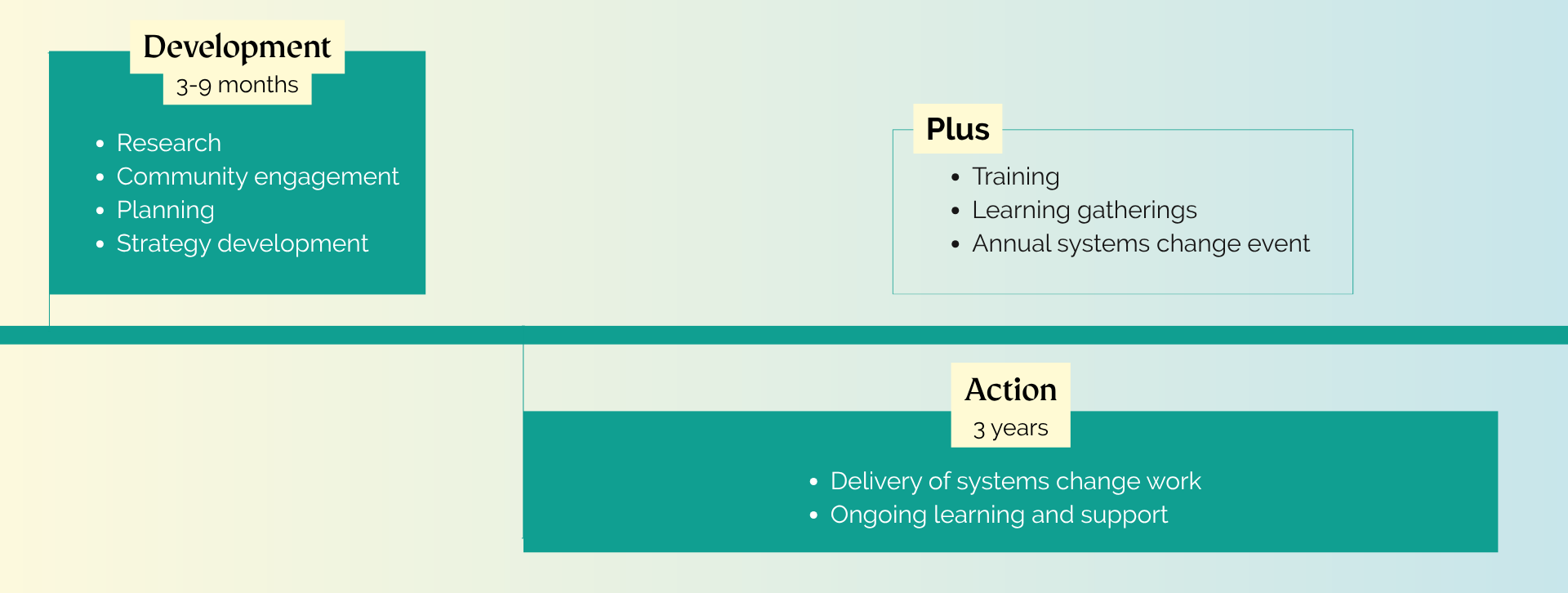
The Fund is split into two phases. The project development phase and the action phase.
Project development phase
Successful applicants will receive £10,000 to design their project – or reflect on and redesign an existing project over a 6 month period. If groups are already clear on their plan, this can be reduced to 3 months, or if they need more time and/or support, this can be extended to 9 months.
During this period you will be developing a 3-year project plan, reporting measures and budget; and finding the people, spaces or opportunities that could help you tackle the issue you have identified.
You will take the lead on how the £10,000 is used. This might include community listening sessions, training, staff time, conducting research, meeting with other organisations, and so on.
The ARJ Funding Officer and the ARJ Leadership Group will be on hand to support you.
You will also have the support of the ARJ Learning Community, made up of all the grant holders and the ARJ Leadership Group. Regular meet ups with the other funded groups and training sessions will provide an opportunity to share skills and knowledge and address challenges together.
All groups and organisations that successfully develop a project plan and budget will be awarded funding.
Action phase
Once the project plan is in place, the action phase begins, which is the 3-year period of grant funding.
You will continue to meet together as the ARJ Learning Community, anticipated to be around 4 times per year. This can be accounted for in your project plan and budget. The benefit of this is that you will build relationships , can bounce ideas with, and can get support from our dedicated staff member and our Community Leadership Group* – all of whom will be Black people and PoC with knowledge and interest in tackling systemic racism as well as their own community networks. We can also help you get access to training and support from others, based on your needs.
Throughout the Action Phase, and particularly towards the end of the funding period, we also intend to be advocates for your organisation or project. In particular, we want to make use of our connections and expertise in funding to help you sustain or grow your work. This could be by helping you: figure out what your funding needs are; put together budgets that actually meet your needs; get relevant training from others; hear about relevant funding opportunities; advocate for more sustainable funding; or review your funding applications.
If your application is successful, you will receive a £10,000 development grant. The project development phase can last for 3, 6 or 9 months depending on how much time and support you need. In order to progress to the full delivery grant, you will need to produce a realistic and practical plan for your proposed systems change work that aligns with your organisation’s existing work, sets out next steps, and explains how you will involve your community in shaping the work.
This will need to include a well-defined systemic racism issue affecting your community, with evidence of understanding of root causes, power dynamics and key stakeholders, alongside a clear statement of the change you want to achieve and, importantly, the specific activities or tactics you are going to use to work for this change. You will need to demonstrate that your approach is community-led, collaborative and informed by those most affected, and show how your work takes account of intersectional experiences. You will have identified risks and made a plan for how you will learn and adapt as your project progresses.
To support this, you will also need to produce a clear and realistic budget that reflects your plans.
If you do not spend your full development grant within the development phase, you can incorporate the remainder into your project budget to cover ongoing learning and development costs.
Within this Fund we are trialling a new approach to how funding relationships work by introducing a peer-to-peer reporting model. This means that, instead of reporting directly to The Robertson Trust, you would reflect on your work with another funded organisation working in a similar area.
We believe that organisations doing similar work are often best placed to understand each other’s impact, challenges and support needs. While the Advancing Racial Justice Fund is closely connected to communities through our staff team and ARJ Leadership Group, this approach recognises the value of shared experience and collective insight.
For you, this approach is intended to:
Create space for more open, honest and meaningful reflection on your work
Build relationships, trust and learning between funded groups
Offer insight and feedback from others who understand your context
We also hope it will:
Strengthen transparency and collaboration across the groups we fund
Shift power and accountability, so that we are all accountable to each other for the impact of our work, not only to the funder
Internal staff will carry out due diligence checks to ensure that we have all of the necessary information from you. Your application will then be assessed by two members of the ARJ Decision-Making Panel. The ARJ Decision-Making Panel will then meet in person to discuss the applications and make decisions about who will receive the grant.
The ARJ Decision-Making panel is made up of independent community leaders who all have lived experience of racism. They will assess applications and decide who gets funding. To help guide their decisions they will use assessment criteria that have been developed collaboratively between BPoC community leaders and Trust staff.
When they assess your application, they will be looking for the following information:
SYSTEMIC RACISM ISSUE
The change you want to see.
Any research, evidence, stories or learning that helped you identify and understand the issue.
Who you want to engage, influence or challenge through your project, and why. You may like to include initial thinking on how you would go about doing this.
APPROACH
Ways that your work is/will be community-led and collaborative
Ways that your work intentionally addresses how overlapping systems of oppression impacts the issue or how people can participate or take action.
PROJECT PLANNING
Consideration of how this systems change project sits alongside your existing work, both in terms of mission and practically.
A clear practical plan for the project development phase.
Consideration of any risks or challenges you anticipate and how you would mitigate these.
We understand that different organisations and groups will have different levels of experience around systems change work, and different ways of describing what they do and why it’s important. We encourage you to be specific about the identities and experiences of your community, and use the language and terminology that your group, organisation or community uses to describe themselves and their own experiences.
If we are not sure about anything in your application, we will follow up with you.
We have a limited amount of money to award, £1million in total, so it is unlikely that everyone who applies will receive funding. Please don’t let this stop you sending an application. We are looking to support as many groups as possible, and want to support groups that wouldn’t usually get the chance to run projects like this.
There will be events and training happening over the course of the Fund that will be open to groups who did not receive funding. We hope that this Fund can strengthen the anti-racism ecosystem in general through providing these opportunities for connection, collaboration and sharing learning.
You can send a written or video/audio application using the form here.
You can choose to upload a video application to answer the narrative questions but you will still need to use the form to give us contact details and upload documents unless you cannot do this for access reasons.
To apply via video, please record your video and upload it to YouTube as an unlisted video. Please copy the link into the relevant box in the form.
If you have any communication support needs that make completing the application difficult or impossible – including needing translation support for this guidance document and the application process, or wanting training in application writing – please get in touch with us by emailing ARJ@therobertsontrust.org.uk or calling 0141 353 4321.
After an initial assessment phase, we will get in touch with you if we have any further questions about your application or would like you to further refine your application. This initial assessment will be carried out by the ARJ Funding Officer and another member of The Robertson Trust’s funding team. Final assessments of applications and funding decisions will be carried out by an anonymous panel of BPoC community members in Scotland, who will have been recruited through an open application process.
While timelines may vary as we respond to the level of interest and need for the fund, the estimated application process timeline is as follows:
Deadline for applications: 14th October 2026, 9am
Outcome: March 2027
We will not close the Fund earlier than advertised.
To send a video/audio application, you will need to upload your video/audio file to YouTube, set it as unlisted, then copy and paste the link into the form.
If you are an unconstituted group, you can still apply to the ARJ Fund. If successful, your funding will be managed through The Social Change Nest (SCN), who will act as your fiscal host.
If your group has a different legal structure but you think working with the fiscal host would work best for you, please get in touch.
A fiscal host is a legally registered organisation that holds, manages, and distributes funds on behalf of unincorporated community groups, social movements, or grassroots projects.
This means SCN will receive and manage the grant on your behalf, while you lead the work.
How It Works
Grant Agreement
Once your grant is approved, you sign up with SCN, signing a term of service agreement with them. This agreement is between your group and SCN.
SCN will sign the grant agreement on your behalf. This agreement will be between SCN and The Robertson Trust.
SCN uses a consistent agreement structure across all the groups they support
Hosting Fee
SCN charges a hosting fee to manage your grant.
Typically between 8% and 15%, depending on the needs of your group
Typical costs
8–9%:
If funds are mainly spent in the UK
Minimal international payments
Higher fees may apply if:
Your project requires more support or complexity
What the fee includes
A dedicated Relationship Manager who can support you with different aspects of your project, depending on what you need. This might include:
Budgeting and financial planning
Project delivery
Governance and group development
Important for your application
The exact fee will be agreed with SCN
Depending on the amount, the ARJ Fund will:
Cover the full fee, OR
Set a maximum amount with any additional costs included in your budget
Employment and Payroll Support (Optional)
SCN can also support you to employ staff
This is done through their partner organisation, Social Change Hive (SCH)
In this case:
Staff are employed jointly by SCH and your group
This comes with an additional fee, which you may need to cover from your project budget
Onboarding Process
If your application is successful, SCN will support you through a structured onboarding process:
1. Due Diligence
SCN will collect key information about your group, including:
Safeguarding approach
Group agreements
Expenses processes
Data protection
Health and safety
This is reviewed by their risk and compliance team
They will provide you with templates of the above policies and you can receive support to complete these if needed
2. Contracting
You and SCN will sign an agreement setting out:
Roles and responsibilities
How funds will be managed
3. Set-Up
SCN will:
Assign you a Relationship Manager
Receive and hold your grant funding
Ringfence the funds for your project
You will then:
Access funds in line with your agreed plans and budget
There are significant limitations to how you can access your funds and it’s important that you bear this in mind.
They can (within 2 working days):
Pay invoices
Order items to be sent to you
Reimburse you for items you have already bought
They cannot:
Provide you with petty cash
Approve purchases that are not covered by the grant agreement
Key Reassurance
You do not need to be a registered organisation to apply
SCN is there to:
Handle financial and legal processes
Support you to deliver your work safely and effectively
You will still:
Lead your project and make decisions about your work
Need Support?
If you’re unsure whether this route is right for you, or want to talk it through:
Contact: ARJ@therobertsontrust.org.uk
We’ll email you to confirm we’ve got your application and when you can expect to receive a decision.
We’ll aim to tell you the outcome of your application by the end of March 2027 at the latest.
We’ll send all correspondence about your application via email, so it’s important that the email addresses and contact details you provide in your application are correct. We’ll normally contact the person you’ve listed as the ‘application contact’ in the first instance, so it’s helpful if this person is available during the assessment period. Please let us know if there are any changes to the contact details provided.
The ARJ Fund assessment team may get in touch with you during the assessment period and will be able to help you with any changes or updates you might need to make to your application.
If we award you funding
We’ll email you to let you know. Before we can pay your funds for the project development phase, we’ll ask you to provide a copy of a recent bank statement for your organisation’s account (within the last three months). If you are an unconstituted group, there will be a different process for paying your funds through The Social Change Nest, which we will support you with.
At the end of the project development phase, we will have supported you to develop a project plan, reporting measures and budget. We may also ask you to complete other actions before we can pay your funds for the grant period. For example, we might ask you to provide evidence of other funding or let us know when a new postholder has been appointed.
Once we have the information we’ve asked for, we’ll do our best to pay the funds to your organisation’s bank account within two weeks.
The ARJ Funding Officer and the ARJ Leadership Group will visit you during the project development phase or at the beginning of the grant period to get a deeper understanding of your work and how we can best support you.
During the grant period, there will be several opportunities to connect to the ARJ Funding Officer, the ARJ Leadership Group and other successful applicants to the fund through events, learning spaces and planning spaces. We may also ask to visit or have meetings with you directly to find out how you’re getting on and whether you need any additional support from us.
You will also have access to Funder Plus, our system for seeking out or funding specific training or support that you need, or that you identify together with the ARJ Funding Officer. You can find out more about this on our support for grant holders webpage along with an ARJ specific guide that grantholders will receive.
We’ll ask that you put together a brief reflective report at the end of each grant year describing and reflecting on your progress, and the impact your work has made. Following our peer-to-peer reporting process, you will share this report with another organisation funded through the Advancing Racial Justice Fund and meet with them to discuss your report. We may use information from your report to highlight stories and case studies used as part of our Communications work. We will plan this process in more detail together.
Throughout the grant period, and particularly as you approach the end of your grant, we know you may be thinking about further funding. The ARJ Funding Officer will help you consider your funding needs and seek out relevant funding during the grant period, and particularly towards the end of the fund.
You might want to consider applying to The Robertson Trust’s other grants. These grants cannot fund work that is already funded by the Advancing Racial Justice Fund, but could help you sustain other areas of your work.
If we do not award you funding
We’ll send you an email in which we’ll try our best to explain why we’ve not awarded you funding, and point you towards further support.
If you would like to have a chat with us about our decision, you can email us on ARJ@therobertsontrust.org.uk and your Funding Officer will aim to get back to you within ten working days.
Have a question about the Advancing Racial Justice Fund? Join one of our online Q&A drop-in sessions.
These informal sessions are an opportunity to ask questions about the fund, application process, eligibility, or your idea for systems change work. There is no set agenda or presentation - simply come along and get the information you need.
You can join at any point during the session and stay for as long as you like. You can click on the links below to book your spot.
This fund aims to be:
A redirection of funding to Black and PoC communities. A central inequity in charitable funding is the systematic exclusion of Black and PoC-led community groups and charities, who are left in a desperate and inescapable cycle of barely getting by. This fund aims to help redress that balance by providing meaningful, sustainable funding to Black and PoC-led groups and charities. We believe it is the responsibility of funders to reflect and act on how systemic racism works in the funding sector. Some major issues include the unsustainable funding for BPoC-led community groups and charities, and the expectation that these groups are only relevant to frontline support or as subjects of consultation, rather than leading decision-making and system change.
An investment in community-led, antiracist systems change. The vast majority of funding for BPoC communities goes towards responding to the trauma and poverty caused by systemic racism, rather than challenging the systems themselves. Meanwhile, BPoC-led community groups and charities are usually too overwhelmed by underfunding and the urgency of need in their communities to be able to step back and consider the long term. This fund aims to invest in these community organisations’ lived experience, community trust, and in-depth, practical knowledge of the problem – by providing that space to reflect, collaborate and fight back.
An exploration of new, more collaborative, ways of working. To achieve racial justice in Scotland, one of the first systems that needs to change is funding. Beyond what and who we fund, the Advancing Racial Justice Fund is a trial of a new type of funding relationship, where we work alongside communities and funded organisations as partners, rather than solely as finance and impact overseers. This involves testing collaborative decision-making structures and reporting models that are new to The Robertson Trust. We expect to make mistakes and learn from them, and aim to embrace the uncertainty that comes with trying to build new systems and ways of working.
You can learn more about how we built the Advancing Racial Justice Fund here.
We’ve done our best to make sure the above guidance is clear, however, if you have any feedback on this, we’d welcome the chance to talk to you about it.
If you have any questions about applying, please contact us at ARJ@therobertsontrust.org.uk