

Jim McCormick, Chief Executive
Last week marked a pivotal moment in Scotland, as newly elected MSPs met in Holyrood to begin the new term, after an election that generated continuity and change, hope and anxiety. The 2026 –2031 term will see the culmination of two ambitious commitments from the Scottish Government: to significantly cut child poverty and to deliver The Promise, both by 2030.
Scotland remains the only part of the UK to have set in statute targets to significantly reduce child poverty underpinned by legislation which carried unanimous support from parties previously elected to Holyrood. The Promise, also with strong cross-party backing, aims to break down silos in policy, budgets, scrutiny and services, and deliver upstream integration leading to fundamental improvements in the lives of children and families in, or on the edges of, care.
These commitments are at the heart of our mission: to prevent and reduce poverty and trauma in Scotland. While we can expect the consensus among MSPs to continue, we should also expect more challenge around the means to achieve these goals as well as the ends, and more soul-searching around fundamental aims.
The focus on 2030 forces us to confront the reality that while Scotland is seeing gradual progress on some fronts, the weight of cumulative evidence cannot be ignored: we need to raise the bar in order to solve child poverty, and go further in breaking the cycle between deep, persistent poverty and intergenerational trauma.
Child poverty is now significantly lower in Scotland than in the rest of Britain, due to the role of housing and social security. A ten-year programme to build a devolved benefits system rooted in dignity and respect demonstrates that public policy can still make a tangible difference in our lives. That is good for restoring trust in an age of polarisation, but cold comfort for the families of one in five children whose lives are restricted and restrained by poverty, with long-term scarring effects too often seen in educational attainment, employment and earnings, health and relationships. The evidence tells us that poverty in Scotland today is real, costly, damaging but not inevitable. With decisive action, across childcare and education, whole family support, fair work, affordable housing and social security, we are more likely to address poverty in the here-and-now, boost prospects and prevent future risks.
If we go back to March, and the final days of the last government, a new Tackling Child Poverty Delivery Plan was published. Bringing Hope, Brighter Futures appeared too late for scrutiny at Holyrood and barely featured during the election campaign. It is a gap that needs to be filled soon. In various ways, the Plan points in the right direction: addressing the burden of public debt faced by low-income households, mitigating the Local Housing Allowance freeze, embedding money advice services in more places, improving transport and employment integration and a renewed focus on child maintenance. While the latest delivery plan outlines future intentions, it is notably light on what has worked (and not) to date, on independent evaluation of previous plans and on what should now continue or change at pace as a result.
OECD-wide evidence consistently shows that improving outcomes for children in low-income households depends on boosting incomes and reducing essential costs, and on providing high-quality early years and whole-family support. These are not competing priorities. We need to resist the lure of either/or thinking at a time when easy choices are on offer. A both/and investment approach is the surest route to preventing and reducing poverty sustainably - one that recognises the reality that financial security and relational support are deeply connected. A looming large deficit in public finances should focus minds on early, effective action and consistently better delivery. Progress on integrated budgets is the first test we think Ministers and MSPs need to meet in this new term. Tackling poverty cannot be down to one department of government.
June marks 15 years since the Christie Commission published its compelling case to put prevention at the centre of public services. Too often, ambitions have withered due to fragmented policymaking and budgeting, short-termism and risk aversion. We have not made a decisive move to build services around outcomes that matter in our lives - meeting needs, upholding rights and boosting life chances. Recent analysis of Scottish election manifestos tells us that parties refer to prevention in different ways but with far less clarity on how integrated and sustained approaches to poverty, housing, childcare, employment and health can be delivered in practice.
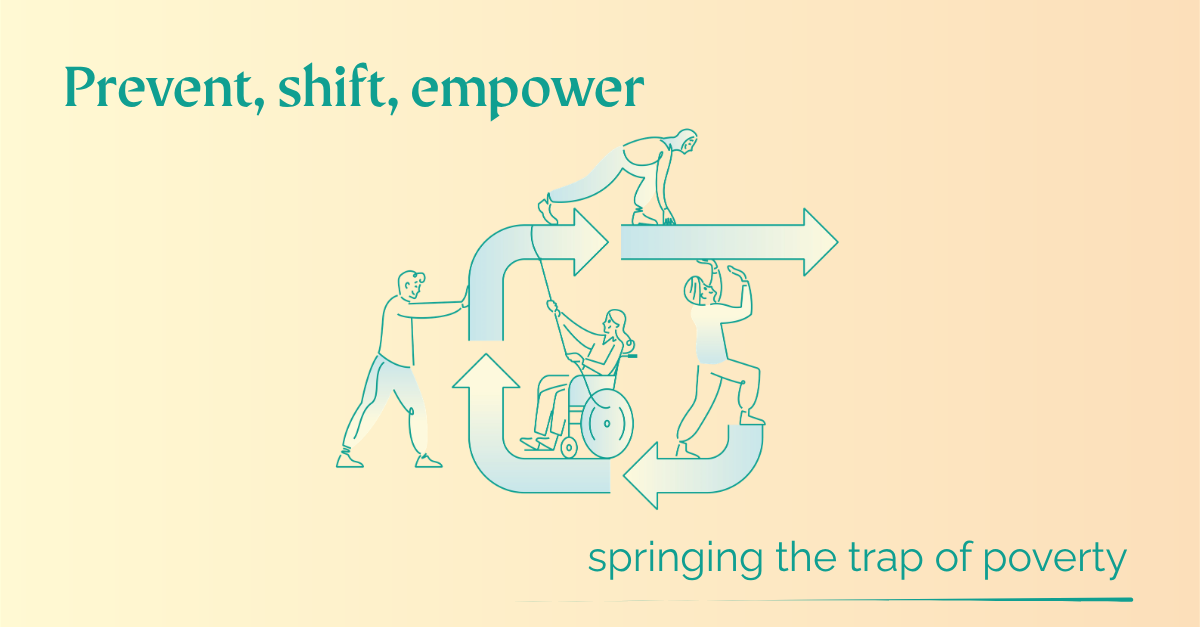
Change involved patient, skilled working led by those best able to build trust. This is where our grantholders come in. Despite so many facing rising demand, more complex needs and escalating costs, charities and community groups demonstrate every day what it takes to spring the trap of poverty and trauma. We have been grappling with how to tell the story of the difference they make – to identify patterns in their practice and draw out the lessons for funders and policymakers. Last year, our Impact and Insights work focused on how lives are being changed in terms of financial security, fair work and education. This year, we are shaping our analysis around three pillars of our own delivery plan, Change Takes Trust: Prevent, Shift and Empower.
Prevent
It is not too easy to work upstream when the waves of need threaten to overwhelm. Yet, we see many powerful examples of acting early and embedding broad support for people facing hardship. We are more likely to prevent if we are clear on how to unpack this big challenge with everyday examples – like addressing hunger. The need for emergency food is the clearest of signals that we are off-track. In response, we have co-funded Trussell’s work preventing the need to return to a foodbank more than once via cash-first support combined with ongoing practical, relational support and advice. It is tea with solutions not just sympathy. Trussell’s Pathways to Advice and Cash Scotland initiative in six locations (urban, rural and island) illustrates three levels of prevention: foodbanks respond to harm from hunger (level 3), access to cash and holistic advice reduces the need to return to the foodbank (secondary) while primary prevention is for governments and employers to address the root causes of food poverty by improving system features such as benefit sanctions, the five-week wait for Universal Credit and unpredictable earnings.
For families with children under five, the Home Start network erodes long-term cycles of poverty and trauma through early identification of risks and barriers and provision of whole family support driven by peers and volunteers. Home Starts work alongside Health Visitors and other community services. They build scaffolding around families to prevent issues spiralling and children moving towards care. For example, Home Start Kirkcaldy has a shared referral system with The Cottage Family Centre, which offers specialist trauma counselling for children and families as part of their broader community anchor work. This records data on FORT (Fife Online Referral Tracking System) to gauge improvements in children's wellbeing, safety and resilience, parenting capacity, relationships and caregiver confidence, family finances, living circumstances, access to community resources and public services. Progress on data sharing is the second test we believe government and parliament needs to meet.
For older children, there is agreement on the need to prevent disengagement from education and to reduce the poverty-related attainment gap. Achieve More Scotland deliver structured programmes of community-based sports and youth work activities in partnership with primary and secondary schools – one of many youth work examples seeking to drive collaboration. When it comes to employment and training for young people at risk of dropping out, Tullochan in West Dunbartonshire and Works+ in the Scottish Borders offer distinct approaches tailored to population and place.
Elsewhere, grantholders are also working to prevent tenants from being evicted, reduce the odds of people in prison losing family contact and disrupt the pattern of domestic violence which remains, shockingly, prevalent.
Shift
The need to ‘shift the system’ overlaps with the goal of prevention. It has proved elusive for similar reasons. While there is no single definition of what this looks like in practice, getting clearer on which system parts we are seeking to change, for whom and how, will bring us closer.
Truly affordable and accessible childcare remains a challenge for Scotland and the UK as a whole. But it is solvable – look at many of our peers in Europe and Canada. The Trust co-funds Flexible Childcare Services Scotland, driving much needed change in the childcare model by embedding low-cost, flexibility, quality and choice for parents who may need to work shifts at short notice.
Aberlour are working with local authorities in Tayside, and now across Scotland, to show how the system of public debt recovery, notably for council tax arrears, can be handled very differently by local authorities. This can relieve households of escalating debt and support engagement with other types of support in place of stigma and shame.
Aberlour’s work is recognised as a model to build on in the new child poverty Plan. So too is the work led by One Parents Families Scotland, Fife Gingerbread and IPPR Scotland on transforming child maintenance, for too long a forgotten piece of the picture. The system that needs to shift will require collaboration between the UK and Scottish governments – a standard we should expect but have seen too little of.
Our partners are also taking system steps towards homelessness prevention, a more humane and effective approach to asylum and community cohesion and enabling more people from low-income backgrounds to enjoy better life chances by thriving in higher education.
Empower
Progress to prevent and shift will take us a long way, but we need to go further. The challenge is not only to move upstream, integrate services and commit to systemic policymaking, but to have a different starting point. We need to root solutions to poverty and trauma with the people and places we are here to serve. This requires independent funders to change course as well as public services, by shifting power.
One example is What Matters To You as a model of voice-led decision making. It is a route to neighbourhood funding for small groups driven by communities in Dundee and Clackmannanshire. It demonstrates a new pattern of collaboration between funders and with councils, with Corra Foundation acting as host and blending its grantmaking expertise with the insights of citizens.
A second example is the Trust’s forthcoming Advancing Racial Justice Fund which will offer funding and support to small/medium Black and People of Colour-led grassroots groups, charities and CICs to pursue system change goals around poverty, trauma and systemic racism. Working with a community leadership group and decision-making panel, it will share power informed by the approach taken by the Independent Human Rights Fund for Scotland.
Recognising the gap in support for emerging grassroot leaders, we are in the early months of our new GLAD initiative which offers funding, coaching, training and wraparound support for 11 lived-experience changemakers pursuing diverse goals on poverty and trauma.
Demonstrating commitment to empowering communities, by moving resources and decisions to where local experience lies, is the third key test for Holyrood.
These are a few examples of the many bright spots we see everyday generated by grant holders who are paving the way to longer-term change. Yet, these remain fragile. We have heard consistently that demand is rising, needs are becoming more complex, escalating costs sit alongside uncertain and reduced financial support from councils. More than that, there is the frustration that progress achieved during the pandemic – on trust, flexibility and speed to enable frontline voluntary organisations to get on with what they do best – has unravelled.
We are clear that lasting solutions cannot be created by charities on their own. This new term at Holyrood needs bold action to drive integration, beyond collaboration, to shift power and to recognise that empowered communities are an essential resource in delivering on manifesto pledges. To complete the long-awaited ‘Christie turn’, deliver on long-term outcomes on child poverty and The Promise, we need to make a decisive break from unduly restrictive, short-term funding cycles and from commissioning approaches that diminish relational working.
In summary, three tests we believe must be met by new Ministers and MSPs are:
- Follow the money: budgets need to be integrated around poverty prevention if we are to reduce the ‘pillar to post’ friction people face.
- Share the data: boost take-up of support packages by improving automated payments for eligible families rather than requiring them to endure multiple assess/refer/claim cycles, within safe boundaries and with citizen consent.
- Empower communities of experience: strengthen design, scrutiny and improvement by driving resources and decisions to people and places with experience of poverty and trauma.
At our recent Prevent, Shift, Empower event, grant holders, partners, advisers, staff and trustees came together to explore what lasting change looks like in practice. The conversations reinforced the urgency of the challenge and the importance of learning from communities already leading change on the ground. Over the summer, we will share further insights and actions for funders and policymakers.
You can keep in touch by signing up to our mailing list. As an independent funder, we will use our convening ability, create influencing opportunities and advocate for change when we are sure of our ground.
Being independent does not mean staying neutral when our mission involves disrupting the causes and cumulative harms of poverty and trauma.
Related content
