
Detailed guidance on applying for a Community Spaces Grant.
If you have any communication support needs that make reading this guidance difficult or impossible, please get in touch with us by emailing funding@therobertsontrust.org.uk or calling 0141 353 4321 to discuss alternative ways to find out about this fund.
We occasionally update our guidance documents in response to external feedback/developments. The guidance was last updated in January 2026 - please ensure you are working from the latest iteration if you are planning to apply for funding.
Prefer to download a PDF version of this guidance?
This funding aims to support local communities experiencing poverty and associated trauma in Scotland.
Registered charities with an annual income* of between £30,000 and £500,000 are eligible to apply.
We can provide revenue funding of between £5,000 and £20,000 per year, for up to 3 years, to support the costs of community centres, hubs or anchor organisations who are delivering and/or hosting a range of services and activities to meet the needs of their community.
By community, we mean a geographic community, for example, a neighbourhood, village or town. This could be in an urban or rural area experiencing high rates of poverty.
Applicants should show how the various services they deliver and/or host relate to preventing or reducing poverty and associated trauma for local people.
You can apply at any time. There is no set closing date for applications.
Please note:
If you are not operating a community hub or other community space serving a whole geographic community, as described above, Community Spaces is not the right fund for you. If your organisation is working specifically with a community of interest (a group of people with shared characteristics and/or experiences), delivering services which directly address a priority described within our funding themes, you may be eligible to apply to our Small or Large Grants funds. You can find more information, including details of our funding themes and priorities, within our Small and Large Grants guidance.
We cannot support capital costs such as building works or refurbishments through our Community Spaces Grants.
* Annual Income: This is normally based on the money your organisation received in the last financial year, as shown in your most recent annual accounts. We understand, however, that organisations’ income may fluctuate from year to year and we’ll therefore look at up to your last three years’ income, as presented on OSCR. If you are a new organisation, which has not yet produced accounts, we’ll look at the income you expect to receive in the year ahead. As a general rule, we will only accept applications for Community Spaces Grants from charities whose annual income is between £30,000 and £500,000. There are some cases where we will make exceptions, for example, if your income last year was less than £30,000 but you are growing your activities and projecting increased costs, or if your income was above £500,000 but mostly due to one-off income or exceptional reasons. If you would like to be considered for a Community Spaces Grant but you’re not sure if it’s right for your charity, please call us on 0141 353 4321 or email us at funding@therobertsontrust.org.uk and we’d be happy to advise.
Charities who are already in receipt of funding from us through our Large or Small Grants funds. You cannot be in receipt of, or apply for, a Community Spaces Grant at the same time as a Large or Small Grant. If you already hold a Transport Grant from us, however, you can also apply for a Community Spaces Grant, provided you meet the eligibility criteria outlined above.
The following types of organisation are not currently eligible for funding from us through our open, responsive grant streams, including Community Spaces Grants:
Housing Associations and Arm’s Length External Organisations (ALEOs - these are organisations which are formally separate from the local authority but still subject to its control or influence).
At present, CICs are not eligible to apply to our open funds. Due to the immense pressure the organisations we already fund are experiencing, we want to ensure we can continue meeting their needs effectively before expanding our applicant pool. Larger asset-locked CICs are however able to apply for our Programme Awards and, as our Social Impact Investing work opens, we envisage being able to offer affordable loans to some asset-locked CICs whose work is strongly aligned to our mission, via investment partners. You can sign up to our mailing list to keep informed of future opportunities for funding.
We are committed to reviewing our guidance and criteria across the course of our strategy. To be kept informed, please sign up to our mailing list.
A minimum of three unconnected Trustees on your charity’s Board. By unconnected we mean not related by blood; married to or in a civil partnership with each other; in a relationship with each other or living together at the same address.
Recent independently examined or audited annual accounts. If your organisation is a newly registered charity which has not yet produced accounts, we’ll ask you to send us details of an independent referee who knows your work well, a recent bank statement and a projection showing your organisation’s expected income for its first year.
A bank account in the name of your charity, with two unconnected people required to make every withdrawal or payment.
A safeguarding policy. If your organisation directly supports children and young people or vulnerable adults, we would expect you to have an appropriate policy document which sets out how you will keep them safe.
Through our Community Spaces Grants, we want to support local community centres, hubs or anchor organisations who are delivering and/or hosting a range of services and activities in places* with higher rates of poverty and associated trauma.
We have identified four funding themes which we think are essential components of preventing and reducing poverty and associated trauma in Scotland:
Financial Security - improving income adequacy, income security, manageable costs, financial safety nets and advice for those most at risk of poverty and trauma.
Education Pathways – preventing and reducing poverty and trauma through access and engagement in early years, education, training and learning.
Work Pathways - improving access to good and fair work that can prevent and reduce poverty through increased pay, hours, and career progression. This also includes employability support, focused on areas or groups with lower employment rates.
Nurturing Relationships - supporting restorative, trusting and healthy relationships within families and communities, to help break the cycle between persistent poverty and intergenerational trauma, and support lasting recovery from the impacts of poverty-related trauma.
Our Community Spaces Grants will fund community centres, hubs and anchor organisations who are working to prevent and reduce poverty and associated trauma, whose work does not neatly align with one specific theme. Their work will cut across these themes, by delivering/hosting multiple services which create strong, supportive and connected communities, for people who are experiencing, or at greater risk of experiencing, poverty and associated trauma. Services and activities should be focused on helping to prevent or reduce the issues local people and places are facing related to poverty and associated trauma.
We are particularly interested in funding applications from organisations who can show how they reach out to and remove barriers for groups of people in their community who are at higher risk of experiencing poverty and associated trauma, such as disabled people, people experiencing racial inequity and asylum seekers and refugees, to ensure that they know about and can access the services and activities on offer in their community space.
* We recognise that whilst SIMD and other measures can give an indication of disadvantage in a geographic area, they don’t always adequately show this, for example in remote and rural communities where there may be smaller pockets of disadvantage and related issues of stigma. We are open to hearing from applicants about how the challenges in their community relating to poverty and associated trauma show up day-to-day, and how their work helps to address these.
We can contribute towards the costs of work which:
meets people’s immediate needs around poverty and trauma
provides earlier help which aims to prevent or reduce the likelihood of experiencing negative outcomes relating to poverty and trauma
tests new approaches or does more of what works
Poverty & Trauma
Poverty means not having enough money to be able to buy the things your household needs and to participate fully in society. We know that often where people experience poverty, they may also experience related types of trauma. We are concerned specifically with the trauma that impacts within families and where a significant contributing factor is the experience of poverty, especially deep and enduring poverty. Risks include neglect and abuse in childhood, and domestic abuse in adulthood. We are therefore interested in funding work which seeks to address poverty and trauma together.
We recognise that many organisations applying for a Community Spaces Grant are likely to be focused on addressing poverty primarily, and that related forms of trauma may feature less strongly in their work. That’s ok. We will also fund work that is focused solely on preventing or reducing poverty through this fund.
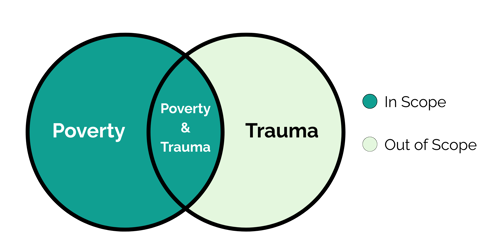
If you’d like to understand more about our focus on trauma, please visit our Nurturing Relationships page.
Project Examples
Examples of the type of Community Spaces Grant we might award include:
Funding towards the running costs of an accessible community hub based in a town with high levels of deprivation. The hub hosts and delivers a range of services for local people, including community meals, family activities, a youth group and drop-in sessions with partner organisations such as the Citizens Advice Bureau and local employability service. The organisation works closely with a nearby charity supporting refugees and asylum seekers, to ensure they know about and can access the services at the hub.
Funding towards the running costs of a village hall in a rural community, where there are no other community facilities. The hall is used to host a range of groups and services, such as a parent and toddler group, a food pantry and warm space, and provides access to IT facilities.
Revenue funding of between £5,000 and £20,000 per year, for up to 3 years, depending on your need or request.
Please note that whilst we can provide Community Spaces funding of up to £20,000 per year, we won’t be able to award this to all applicants. We scale awards based on a number of factors, including the size of the applicant organisation and its costs, the scale of its work, and the strength of alignment between its work and the aims of our fund.
We can consider unrestricted funding, which can be used to support any costs within your organisation, to help you further your work. We would encourage organisations to apply for unrestricted funding, however, we may award restricted funding if there are elements of your work that do not fit with the aims of this fund.
Alternatively, we can consider restricted funding for a specific salary, project or service, including any associated equipment costs, such as laptops. We can consider fully funding a small project or part-time salary, or part-funding a larger project, service or full-time salary.
You don’t need to have any match funding in place when you apply, but if we are not able to fund the total costs of your work, you will need to consider additional sources of funding. Our Funding Officer will discuss this with you during the assessment process.
Due to the high levels of demand for our funding, you can only hold one Community Spaces Grant from us at a time.
We’re happy to fund most costs, but there are certain costs and activities we would not consider supporting:
Work which takes place outside Scotland
Capital costs such as building or renovation works, although, as above, we may consider small items of equipment as part of your revenue request.
Work which seeks to address forms of trauma which are not connected to experiences of poverty, for example, trauma caused by a car accident, bereavement or illnesses experienced across the general population.
Funding for individuals (by this we mean we won’t provide funding which will primarily benefit only one or a very small group of individuals, although we could consider funding to provide e.g. vouchers to individuals to help with the costs of essentials, as part of the services delivered in your community space).
Whilst we can provide funding to faith-based organisations delivering services and activities for the wider community, we cannot contribute towards projects and activities which incorporate the promotion of religious (or political) beliefs, or requests for salaried posts and volunteer costs where there is a requirement to be of a particular faith or none. This is because of the Trust’s commitment to support and enable equal access to activities, employment and volunteering opportunities, regardless of whether an individual is of a particular faith or none.
Feasibility studies or academic research.
Whilst we won’t fund the costs of mainstream childcare, we recognise that many organisations applying to this fund may be delivering or hosting a childcare service, such as afterschool care, within their community facility, often to help remove barriers to local people accessing employment or training. If that is the case for your organisation, it would be acceptable to include any costs related to this provision (if directly incurred by your organisation) as part of your overall budget, however, we would not consider contributing towards the costs of a childcare service in isolation through this fund.
Day care or residential care for older people.
Standalone events or festivals – i.e. events that are not part of a larger programme of work relating to poverty and associated trauma.
Any retrospective costs already incurred by the applicant organisation.
Any costs not incurred by (or the salaries of staff not directly employed by) the applicant organisation.
The salary costs of staff who are also Trustees/Directors on the applicant organisation’s Board.
Work which is focused solely on reducing social isolation. We will, however, consider applications where social activities form part of a broader offer of community support, as per the project examples above.
If any of the above costs make up a large part of your organisation’s annual expenditure, we will be more likely to restrict any grant we award you.
We consider a number of key criteria when assessing applications, including to what extent the applicant organisation’s work focuses on:
Preventing or reducing poverty and associated trauma: This is the most important consideration to us as a funder and will influence the level of funding that we are able to offer. Organisations should show us that they recognise the challenges people in their community are facing in their lives related to poverty and associated trauma, as well as how their organisation’s work will respond to this and support them, or how it will work to prevent future experiences of poverty and associated trauma, where possible.
Community participation: Organisations should show that they involve their community in the organisation, for example on the Board or through volunteering; and that they listen to their community and respond to their needs, for example, by gathering feedback and taking action on this. We are also interested to know how applicant organisations include people from diverse communities (for example disabled people or people experiencing racial inequity) and remove barriers to their participation.
Collaboration: Organisations should show that they are aware of other groups and services in their area and are linked in with them, for example, through hosting other organisations within their hub or centre, so that people can easily access their services, making or receiving referrals, partnership working or participating in local networks.
Other criteria we consider include:
The size of grant the applicant organisation is asking for, relative to its annual income – we try to be proportionate in how much we award.
The organisation’s financial position, including its sustainability and whether it has an immediate need for our funds.
How the organisation is governed, and, where appropriate, the safeguarding policies and arrangements it has in place.
The duration and the scale of the organisation’s work, for example delivered at a local or regional level, and the number of people it will support.
We consider applications for Community Spaces Grants as part of a rolling programme. You can apply at any time, bearing in mind our timescale for decisions, detailed below. You can download a copy of our application questions and help text here.
Please complete the online application form. Within the form, we will ask you to upload:
A copy of your most recent independently examined or audited annual accounts.
If you are a newly registered charity and have not yet produced accounts, we will ask you to provide details of an independent referee (someone who knows your work well but is not directly involved in it), a recent bank statement and a projection showing your organisation’s expected income for its first year.
A budget detailing the costs of your work, including any other funding secured or projected towards these. We ask that you use our budget template (linked within the application form) to provide this information. We would encourage all applicants to ensure that their budget is fully costed and factors in inflation, along with costs for evaluating their work, as appropriate. As we appreciate that many charities are currently working in a challenging landscape, we would also encourage applicants to include any costs associated with supporting staff and volunteer wellbeing, to help maintain organisational resilience.
If you are applying for a contribution towards salary costs, please provide a job description for the post, including contracted hours per week and salary scale.
We recognise that many organisations now use AI tools as part of their day-to-day work, and we understand the potential value they can bring when preparing an application. You can use AI to support your submission, but please make sure you read our guidance before you do so.
Our guidance explains what we expect from applicants, how information should be presented, and the standards your application must meet. It’s important that your final submission reflects your organisation’s own ideas, plans, and evidence — not content generated solely by AI.
If you choose to use AI tools, please ensure that:
We’ll email you to confirm we’ve got your application and when you can expect to receive a decision.
We’ll aim to tell you the outcome of your application within 10-12 weeks. This is dependent on receiving any additional information we may ask for – delays in receiving this extra information could mean the decision takes longer. As we have been receiving increased numbers of applications across Our Funds, there may be times where we have to extend our published turnaround times. We will do our best to respond to requests and assess new applications within our published deadlines, but if there are any changes to this we'll either communicate this in advance and/or notify applicants on an individual basis.
We’ll send all correspondence about your application via email, so it’s important that the email addresses and contact details you provide in your application are correct. We’ll normally contact the person you’ve listed as the ‘application contact’ in the first instance, so it’s helpful if this person is available during the assessment period. Please let us know if there are any changes to the contact details provided.
We’ll assign one of our Funding Officers to assess your application. They may get in touch with you during the assessment period and will be able to help you with any changes or updates you might need to make to your application.
If we award you funding:
We’ll email you to let you know. Before we can pay your funds, we’ll ask you to provide a copy of a recent bank statement for your organisation’s account (within the last three months).
We may also ask you to complete certain actions before we can pay your funds. This is more likely to be the case for restricted awards rather than unrestricted. For example, we might ask you to provide evidence of other funding or let us know when a new postholder has been appointed.
Once we have the information we’ve asked for, we’ll do our best to pay the funds to your organisation’s bank account within two weeks.
We’ll ask that you send us a brief report at the end of each grant year telling us about your progress, the differences or outcomes your work has contributed to making for the people and community you support, and what has helped to make those differences. We may use information from your report to highlight stories and case studies used as part of our Communications work. We may also request to visit you or speak to you on the phone to find out how you’re getting on and whether you need any additional support from us.
As you approach the end of your grant, we know you may be thinking about further funding. You can reapply to us from 6 months before the end of your grant period. If successful, we would not release any funds before your existing grant ends and you’ve sent us your End of Grant Report.
Take a look at the Support for grant holders section.
If we do not award you funding:
We’ll send you an email in which we’ll do our best to explain why we’ve not awarded you funding. We will also let you know in our email how soon you can re-apply. If the reason we haven’t awarded you funding is something we both think you can address, you may be able to re-apply once you have been able to do so. We’ll explain this in the email. If the reason you have been unsuccessful is something we don’t feel can be easily addressed, we will ask you to wait 12 months before considering reapplying.
If you would like to have a chat with us about our decision and whether – or how soon – you can re-apply, you can email us on funding@therobertsontrust.org.uk and your Funding Officer will aim to get back to you within five working days.
We’ve done our best to make sure the above guidance is clear, however, if you have any feedback on this, we’d welcome the chance to talk to you about it.
If you have any questions about applying for a Community Spaces Grant, please contact us on the details below:
0141 353 4321