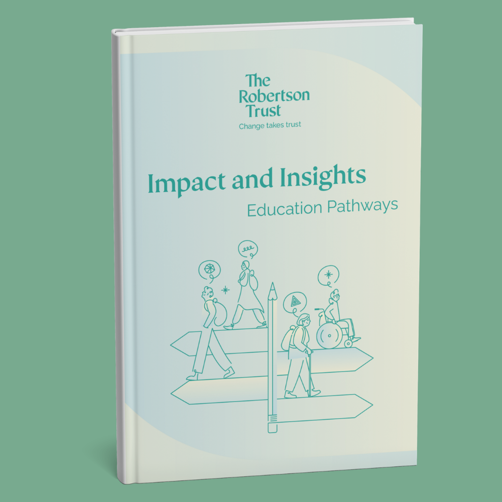

We’re delighted to share our third Impact and Insights Report, focusing on Education Pathways. This report starts to tell the story about the differences we are contributing to within Education Pathways and the implications of what we are learning as we seek to prevent and reduce poverty and trauma in Scotland.
The report explores patterns in practice, relevance to impact, and includes case studies throughout that shine a light on emerging practice, where grant holders are adapting to challenges and testing new ways to increase impact.
What are we learning?
Through our Education Pathways theme, we want to see an education system in Scotland which acts as a pathway out of poverty. We want to support solutions which enable those experiencing poverty and related trauma to access and participate in education, developing skills, capabilities, resilience and achievements that will help them thrive.
Analysis of grant holder reports, external data, and discussions at our collective sense-making event highlight several important insights:
-
Increased complexity: Due to the long-term impact of COVID-19 and the ongoing cost of living crisis, grant holders are supporting young people with much more complex needs, particularly behavioural issues and a significant increase in the number of young people with ASNs like mental health, social and emotional issues.
-
Increased demand: Insufficient funding and capacity within statutory services (including schools, health and social care and employability services) is also driving a significant increase in demand for this intensive support from grant holders.
-
Funding cuts: In addition to rising costs of staffing and utilities, funding cuts and reductions in multi-year funding (e.g. from the Scottish Government and local authorities) are placing significant financial pressure on grant holders.
-
Capturing data for evaluation: Most grant holders are running multiple different projects and programmes but often do not have the capacity or data management systems to capture the large range of data needed to evaluate impact across different areas of their work.
What is making a difference?
Despite current challenges and issues on the horizon, our grant holders are continuing to make a real difference in preventing and reducing poverty and trauma across Scotland. The report highlights patterns in practice and emerging practice, including:
- Education Endowment Foundation - encouraging the use of high quality evidence and embedding this into decision making and teacher practice to improve equity and educational outcomes for children and young people.
- Scran Academy – providing alternative learning opportunities for young people who have disengaged from or are unable to attend mainstream education. The Academy provides non-formal learning in a safe and supportive space for young people, empowering them to gain meaningful work experience and achieve accredited SQA qualifications,
- YMCA Tayside – helping young people gain out-of-school qualifications, particularly young people who face multiple and complex barriers to economic, social and educational inclusion.
- Action for Children – providing transition support such as targeted college programmes in the senior school phase, which are helping to increase positive destination rates. 93% of students who took part in the STAY programme felt more positive about continuing their course.
- Inspiring Scotland – providing mentoring support to children and young people experiencing Scotland's care system. 91% of young people said that having a mentor helped them become more interested in learning.
- Achieve More Scotland – focusing on whole system approaches, where third sector organisations are integrated with schools and activities to improve outcomes for children and young people.
What’s Next?
For us, the event and deep dive into Education Pathways has raised some interesting questions about the potential for third sector organisations to make a more effective contribution to attainment and what our role might be in that, in line with our strategy. We are also considering how we might be able to help create the conditions for effective collaboration in the system, alongside other partners. These are things that we will continue to explore over the coming months.
Further recommendations include:
- Using our position more for advocacy and influencing education system reform, including creating spaces for key stakeholders to come together and have candid conversations about challenges, opportunities and potential solutions for change.
- Clearer guidance from local authorities or the Scottish Government for head teachers and third sector organisations around how to build collaborative partnerships. This could include examples of best practice and how to embed third sector staff in schools which outline their roles and responsibilities.
- The development of a shared measurement framework for both the third sector and schools, which places equal value on skills and competencies and academic attainment, could enable understanding of the collective impact they're having and how that contributes to long-term outcomes.
Stay Connected
Does this align with the work you are doing or how you are thinking? Do you have questions or ideas for us?
You can get in touch with us at TRTComms@therobertsontrust.org.uk.
Understanding Impact
Our Impact and Insights Framework, launched last year, guides our approach to learning. It aims to draw a line of sight between the changes we want to see in Scotland and what we do in our work to fund, support, and influence, and helps us understand:
- The difference we make through our own practice as a funder and through our support and influence objectives;
- The outcomes achieved by funded organisations;
- The contributions we make to social change.
Read more about our approach to understanding impact here.